Are You a Whole
or a half?
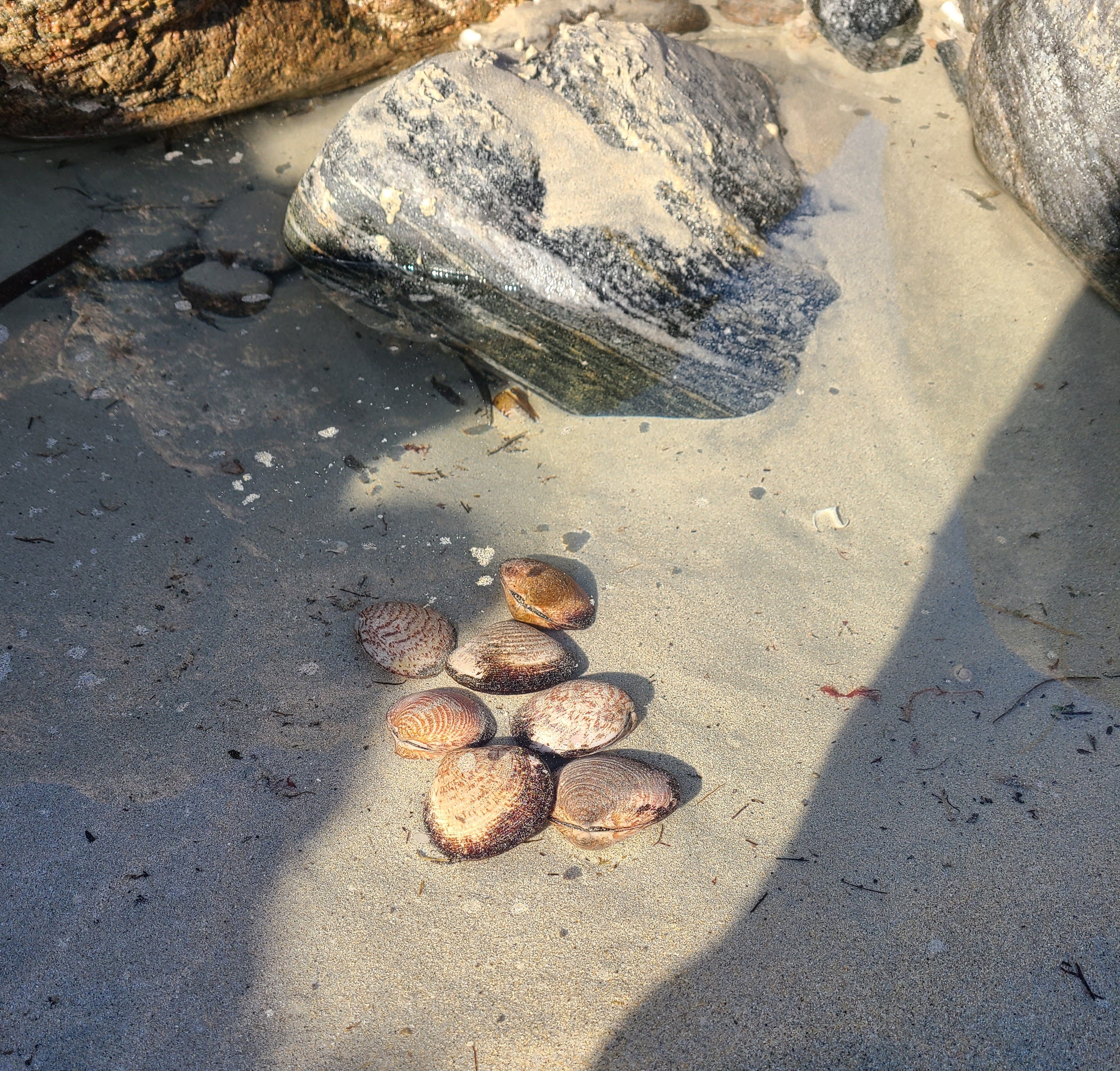
These are the internal voice musings that flutter around your head when you are from the Midwest and alone on a beach. When clams and razorback clams and cockleshells taunt you with their state of aliveness or deadness because either way, they always present face-down. Unless you are foot-dexterous, they require you to bend down and flip them over. Because the wholes are those we might eat and the halves, we will not. Because that’s called collecting seashells on the beach.
My mother used to tell me about when she was a girl growing up in Kentville, Nova Scotia, and how they would find lobsters washed up on the beach after a storm. Last November, Halifax’s Dalhousie University researchers reported that microplastics are being routinely found in Nova Scotia lobsters. That is an expensive way to ingest plastic. (After arriving in Halifax last September, I promptly consumed a lobster roll on the pier and ordered a whole one at a restaurant for lunch the next day.)
I met a man on the bus last year in Scotland whose father was a lobster fisherman. He told me that during his father’s lifetime quest to keep his business income providing a living wage, he never ate one. He never tasted his product. This would sit better with me if he were a lima bean farmer. So, the son - the man next to me on the bus - said that upon his father’s retirement, he went to a fish auction and bought his father two large lobsters, spending approximately 250 British pounds sterling. His father appreciated the gesture, ate them, and declared them delicious. Good grief.
Back to those clams I found on the beach - I brought them home, put them in salted water, and then Googled a recipe for fettuccini and clams. But before I fired up the stove, the Nova Scotia lobster microplastics information returned to memory. I then promptly recruited my friend Amy Ryan to help me decide whether to eat them or not. She WhatsApp’d me a biotoxin report for the Hebridean Islands along with a recipe for clams in tomato sauce. We both decided not. Ditto with the locals here in Tarbert. I asked one of the grocery store owners. In her uncertainty, she asked the guy standing behind me, “Melanie wants to know if she can eat clams she found on Luskentyre beach this morning.” I have never heard someone answer “no” so quickly before.
Turns out, there are potential biotoxins in shellfish here on some beach areas of Scotland, and it can be especially risky with shellfish on the beach after a storm. It never occurred to me that the pristine beaches of South Harris would have any kind of contamination issue, but they do - including E. coli and occasional red algae blooms. I learned that biotoxins like PSP and DSP are invisible and not destroyed by cooking. Unlike riding the bus up to Stornoway in a windstorm, this is not one of the ways I like to live my life dangerously. So, I set them free in the marina down the road. (My friend Steve is reading this thinking, “I don’t eat fish and therefore would never have this problem.” Hi Steve!)
I guess I am a half…
One of my favorite playlists: Water Bodies
YouTube: Luskentyre Beach, 2026
Blessings & Love,